Saturday, August 4, 2012

Day 8 Tuesday, 1 November 2011 Giza

The entire tour group was excited today as we visited the iconic pyramids of Giza.The complex consists of the Great Pyramid of Giza (the pyramid of Cheops or Khufu) the somewhat smaller Pyramid of Khafre (or Chephren) a few hundred metres to the south-west and the relatively modest-sized Pyramid of Mekaure (or Mykerinos) a few hundred metres further south west. The great Sphinx lies on the east side of the complex. Current consensus among Egyptologists is that the head of the Great Sphinx is that of Khafre. Along with these major monuments are a number of smaller satellite edifices known as 'queens' pyramids, causeways and valley temples. The Great Pyramid Complex Khufu's pyramid complex consists of a valley temple (now buried under the village of Nazlet el Samman). This was connected to a causeway which was largely destroyed when the village was constructed. This led to the Mortuary Temple of Khufu and only the basalt pavement remains of this temple. This was connected to the pyramid. We did go inside the great pyramid, and what an experience to actually be inside, however, the climb became too much for me and we did not reach the burial chamber. This pyramid maintains a limited collection of the casting stones at its base. These casting stones were made of fine white limestone quarried form the nearby Muqattam Range. The great pyramid has three smaller queen's pyramids associated with it and five boat pits. Two pits on the south side of the pyramid still contained intact ships one of which has been fully restored. We would visit the display later in the day. Khafre's Pyramid Complex This complex consists of a valley temple (sometimes known as the Sphinx Temple), a causeway, a mortuary temple and the king's pyramid. Khafre's pyramid appears larger than the adjacent Khufu pyramid by virtue of its more elevated location and the steeper angle of inclination of its construction. It is in fact smaller in both height and volume. It retains as prominent display of casting stones at its apex and gives you a glimpse how wonderful the pyramids would have looked before the casting stones were removed.It is believed the removal happened in the Middle Ages to build houses in Cairo. Menkaure's Pyramid Complex This also consists of a valley temple, a causeway , mortuary temple and the king's pyramid. The king's pyramid has three subsidiary queen's pyramids. It is the most modest pyramid and the last to be built here. Impressions It was an amazing experience to see first hand the size and might of these structures. They were even more impressive than I had ever imagined. The hawkers and the locals trying to get you to take camel rides do somewhat spoil the experience. It is a pity they could not be educated in dealing with tourists fairly and without hassling as it would make the experience so much better; however, I practised my bartering skills and faired fairly well. Khufu's Funeral Boat (Solar Boat) After some time at the pyramids, we visited the solar boat museum which houses the amazing Solar Boat found at the base of the Khufu pyramid. The Khufu Boat Museum is a small modern facility resting alongside the Great Pyramid. The first floor of the museum takes the visitor through visuals, photographs and writings on the process of excavating and restoring the felucca. The ditch where the main felucca was found is incorporated into the museum ground floor design. To see the restored felucca, you must climb a staircase leading to the second floor. Floor to ceiling windows allow for much sunlight and the wooden walkway takes you around the felucca where you can get a close view of its impressive size. The Khufu ship is one of the oldest, largest, and best-preserved vessels from antiquity. It measures 43.6 m (143 ft) long and 5.9 m (19.5 ft) wide. It was thus identified as the world's oldest intact ship and has been described as "a masterpiece of woodcraft" that could sail today if put into water.[1] However, the vessel may not have been designed for sailing (no rigging) or paddling (no room). The ship was one of two[2] rediscovered in 1954 by Kamal el-Mallakh – undisturbed since it was sealed into a pit carved out of the Giza bedrock. It was built largely of Lebanon cedar planking in the "shell-first" construction technique, using unpegged tenons of Christ's thorn. The ship was built with a flat bottom composed of several planks, but no actual keel, with the planks and frames lashed together with Halfah grass, and has been reconstructed from 1,224 pieces which had been laid in a logical, disassembled order in the pit beside the pyramid. It took years for the boat to be painstakingly reassembled, primarily by the Egyptian Department of Antiquities’ chief restorer, Ahmed Youssef Moustafa (later known as Haj Ahmed Youssef). The history and function of the ship are not precisely known. It is of the type known as a "solar barge", a ritual vessel to carry the resurrected king with the sun god Ra across the heavens. However, it bears some signs of having been used in water, and it is possible that the ship was either a funerary "barge" used to carry the king's embalmed body from Memphis to Giza, or even that Khufu himself used it as a "pilgrimage ship" to visit holy places and that it was then buried for him to use in the afterlife. The Khufu ship has been on display to the public in a specially built museum at the Giza pyramid complex since 1982. Its discovery was described as one of the greatest Ancient Egyptian discoveries in Zahi Hawass's documentary Egypt's Ten Greatest Discoveries. The Sphinx After visiting the Solar Boat Museum we were taken to the best vantage point for viewing the sphinx with its lion's body and man's head minus its nose and beard. The nose was shattered supposedly by Mameluke Turks who used the monument for target practice. With a length of seventy-three meters, a height of twenty meters and a width of four meters 2 , the Sphinx of Giza is a sculpture carved from a natural promontory of rock. His head is carved from a limestone outcrop of hard plaque Mokattam which are built on the three pyramids, a peak already revered in pre-pharaonic times . It is in front of the large quarry that supplied number of blocks to the pyramid. Her head is turned towards the east . The body of the Sphinx is that of a lion and the head of a sovereign with the nemes , forehead adorned with a uraeus (there are still the place of the front where it was fixed). Long identified with the pharaoh Khafre , son of Khufu , his face might actually represent Cheops himself, as asserted by Vassil Dobrev . Several indices have enabled him to develop his theory, such as observation of his cap , the width of his chin, the shape of his ears or his ceremonial beard . It would Djedefre , son of Khufu and Khafre's brother, who had built the sphinx (or restore his head) to the glory of his father. Moreover, inscriptions indicate that it is Djedefre which would also dismantle and bury the solar boats in trenches, on the south side of the pyramid of Cheops his father so that it can travel to the other world. It is believed that the Sphinx assured as gatekeeper of the site, or perhaps more precisely solar temple built next to the pyramid of Cheops. What a magnificent sight! I could not believe that we were actually standing looking at this wonderful monument that I had wanted to see in person for so long. Everyone, of course, took many photos. Afternoon and evening We returned to the hotel for a very late lunch, early evening meal and then returned in the early evening to see the light and sound show in front of the pyramids. Even though many people thought the show was a little touristy I enjoyed the wonderful spectacle of lights illuminating the pyramids and sphinx as the history of Egypt was told.
Friday, August 3, 2012

Day 7 Monday, 31 October 2011 Alexandria to Cairo

We left Alexandria after a delicious breakfast to travel back to Cairo. We did not travel the same road as before as we headed to El Alamein, the site of Monmtgomery's famous victory over Rommel's Afrika Korps. The visit to the war cemetery and military museum were very moving and the young men employed as tourist guards and guides were respectful and knowledgeable. We spent some time wondering through the rows of graves saddened by the young ages inscribed on the gravestones and grateful for the sacrifices of these young brave men. At the end of the visit we visited the well stocked shop to buy souvenirs and outfits for our Galabeya party aboard the ship as prices were fair and we there were no hawkers. We arrived back in Cairo and settled back into the Mena House Oberoi and in the evening enjoyed our private Egyptology lecture with Hanan

Saturday, June 16, 2012

Day 6 Sunday, 30 October Alexandria

Our first stop today was Pompey's Pillar which is the largest memorial column in Egypt. It is constructed from a single piece of red Aswan granite. The total height is about 28 metres with a diameter at the base of 2.7 metres and towards the capital at the top it tapers to 2.3 metres. It was erroneously dated to the time of Pompey, but the Corinthian column was actually built in 297 AD commemorating the victory of the Roman emperor Diocletian over an Alexandrian revolt. It is guarded by a sphinx. In the middle ages crusaders believed that remains of the the Roman general,Pompey, were in a pot at the top of the column,hence Pompey's Column. There are several monuments situated around the column and the remains of a temple to the god Serapis. During our time in Alexandria we became aware of the 'tourist police' who are charged with protecting tourists from terrorist attack and from being harrassed by hawkers . This force seems to employ a significant number of young men in Egypt. As we were unable to visit the beautiful Bibliotheca because of a strike by workers for better pay and conditions, we headed to the Citadel of Quitbay, a 15th century defensive fortress located of the Mediterranean sea coast upon/from the ruins of the Lighthouse of Alexandria on the eastern side of the northern tip of Pharos island at the mouth of the eastern harbour. It was established in 1477 AD by Sultan Al-Ashraf Sayf al-Din Qa'it Bay and was a delightful place to visit on a sparkling sunny day. After revolution in 1952 and the removal of King Farouk, the Egyptian Navel troops turned the fort into a Maritime Museum. We had lunch at a local seafood restaurant which had wonderful views overlooking the Mediterranean. After returning to our hotel we explored the beach and the shopping mall attached to the hotel once again going through metal detectors as we left and entered the hotel.

Monday, May 7, 2012

Day 5 Saturday, 29 October Cairo to Alexandria

<
After breakfast we drove to Alexandria and saw some of the new towns that were appearing along the main highway through the desert beyond the vast expanse of Cairo. Once again we encountered many different types of transport from modern cars to camels and donkeys. We were fascinated with the domes that looked like bird houses which we saw dotted along the highway and we were informed by Hanan that these were pigeon houses where pigeons were fattened up as they are considered a delicacy and good for male fertility. On arrival in Alexandria, we drove to Kom el Shoqafa Catacombs. This is a multilevel labyrinth featuring dozens of chambers adorned with sculptured pillars , statues and other Roman and Egyptian religious symbols, burial niches and sarcophagi. There is even a banquet room of Roman style where relatives of the deceased conducted memorial meals. The Catacombs are located to the south west of Pompey's Pillar. Many of the features of the necropolis merge Greek, Roman and Egyptian cultural points so although many of the statues are of Egyptian style but feature Roman hair and clothing styles. During the age of the Antonine emperors (2nd century) a circular staircase was used to transport deceased bodies down to the middle of it leads into tombs that were cut into the bedrock. According to tradition,the central chamber is the mass burial chamber for humans and animals massacred by order of Emperor Caracalla. There is a magnificent Roman amphitheatre at the site which we also explored. We noticed that many of the buildings both in Cairo and Alexandria appeared unfinished needing the final coat of paint on the outside or having rods to support another storey protruding from the roof. We were informed that tax was not payable on the building if it was incomplete, so no one bothers to finish off any building. Indeed it looked as if our building inspectors would have no trouble finding major faults with many of the structures. Modern day apartments will not stand the test of time the pyramids have. Later that afternoon, we visited the Alexandria National Museum The Alexandria National Museum (ANM) in Egypt was inaugurated the 31 December, 2003 by Hosni Mubarak and it's located in a restored Italian style palace in Tariq Al-Horreya Street (former Rue Fouad), near the center of the city.. It contains about 1.800 artifacts that narrate the story of Alexandria and Egypt. Most of these pieces came from other Egyptian museums. 1st Floor: Pharaonic time. Mummies are shown in a special underground chamber (basement) 2nd Floor: Graeco-Roman time. Including archeological underwater excavations in Alexandria. 3rd Floor: Coptic, Islamic and Modern eras. The museum is housed in the old palace of Al-Saad Bassili Pasha , who was one of the wealthiest wood merchants in Alexandria. Construction on the site was first undertaken in 1926. We then joined the peak hour traffic to head to our hotel. It was madness as we drove along the cornice beside the Mediterranean, but we eventually reached our luxurious hotel, The Four Seasons. Our balcony had views over to the hotel's private beach on the Mediterranean and we could also see ships lined up to go through the Suez Canal. We enjoyed a delicious dinner at the hotel and then just sat on the balcony watching the passing parade of Alexandria.

Saturday, April 14, 2012

Day 4 Friday, 28 October 2011 Cairo


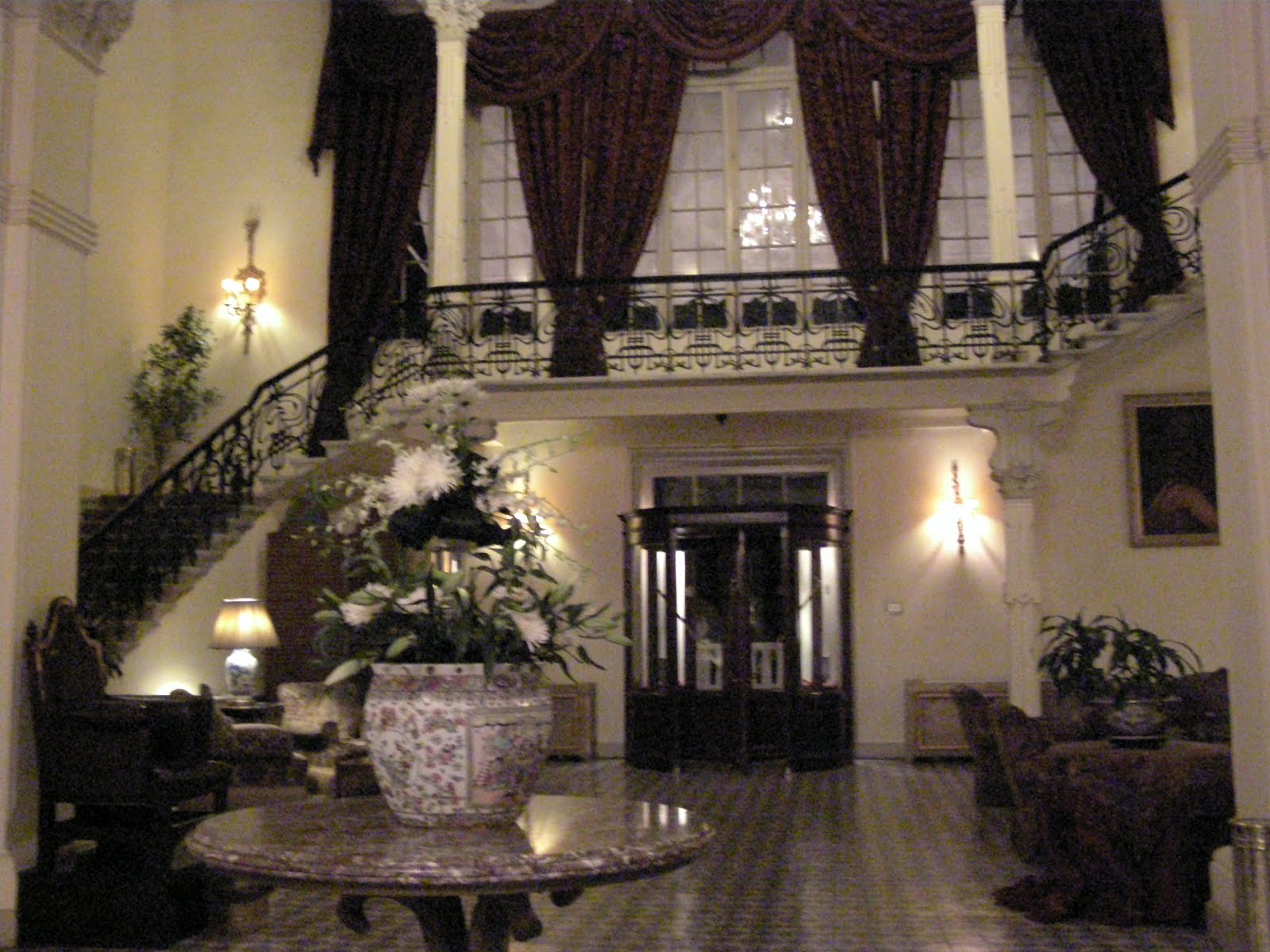
Photos 1-4 Hanging Church 5- Coptic Museum 6-7 saints Sergius and Bacchus Church. We had arrived in Cairo a day early and our tour did not officially start until Friday evening so we decided to take a half day tour that looked at Cairo's main Coptic Churches and museum. On our way to the first stop of the tour we encountered a crowd spilling out from a local railway station. As there had been recent violent protests in Cairo's Tahrir Square which led to the fall of the Egyptian President, Hosni Mubarak, our guide was quite concerned and quickly led us away. Most of the protest we saw during our time in Egypt were peaceful, non-violent civil resistance. Our first stop was 'the Hanging Church' or in Arabic al Muallaqah (the suspended) on Shar'a Mari Girgis Street in Old Cairo. The Hanging Church was built in the 7th century, probably on the site of a 3rd or 4th century church for the soldiers of the bastion. It has been rebuilt several times since then including a major rebuild under Patriarch Abraham in the 10th century. Entrance is via beautifully decorated gates which lead to an open court yard flanked by mosaics. From the courtyard there are 29 steps leading into the church. The church itself is remarkable for its marble pulpit, inlaid screens, icons and murals. The timber roof of the nave recalls Noah's Ark. The 11th century marble pillar surmounts 13 pillars representing Jesus and the 12 disciples. As is customary in Coptic churches, one pillar is black representing Judas and one is grey for doubting Thomas. At the eastern end of the church are three sanctuaries with altars dedicated to the Virgin Mary (centre); St George (left) and St John the Baptist (right). The central iconostasis (sanctuary screen) dates fro the 12th or 13th century. It is made of ebony inlaid with ivory, carved with geometric designs and crosses and has a row of seven large icons. The centre icon depicts the Christ enthroned; to his right is the Virgin Mary, the archangel Gabriel and St Peter; to his left are John the Baptist, the Archangel Michael and St Paul. The left screen has a design of squares with crosses in alternate ivory and ebony, surmounted by 17 icons depicting scenes from the martyrdom of St George.The right screen dates from the 13th century and has a cruciform pattern. Across the top are seven small icons representing the life of St John the Baptist. All icons on these screens are the work of Armenian artist, Orhan Karabedian, and date from 1777. It was a day where services where being held and it was a delight to see families interact at the end of services. Our next stop was the Coptic Museum, founded in 1910 by Marcus Simaika Pasha, which houses the largest collection of Egyptian Christian artifacts in the world. The museum traces the history of Christianity in Egypt from its beginning to the present day and was erected on 8 000 square meters offered by the Coptic Orthodox Church of Alexandria under the guardianship of Pope Cyril v. It contains examples of stonework from many old ruins, ivory and bone carvings, metalwork, glass objects, ceramic and terracotta objects, wall paintings, icons, epigraphy and manuscripts, textiles and Nubian material rescued during the construction of the Aswan High Dam. It was a fascinating place to visit. The third stop was the interesting Saint Sergius and Bacchus Church (Abu Serga) which dates back to the 4 th century. It is believed to be built on the spot where the Holy Family rested at the end of their journey into Egypt. An interesting feature is the crypt where Mary, Joseph and Jesus are said to have rested. It is 10 meters deep and when the Nile levels are high it often floods. The most precious and ancient of the icons are on the southern wall and the vast central hall is divided into three naves by two rows of pilasters. Our final tour stop was the Synagogue Ben Ezra which was originally a Christian church which the Coptic Christians had to sell to the Jews in 882 AD in order to pay the annual taxes imposed by the Muslim rulers of the time. Numerous restorations and renovations were made over the centuries and the present building dates from 1892 and is a faithful reconstruction of the building that had collapsed. During the reconstruction, a medieval geniza (a hiding place for sacred books) was discovered, revealing thousands of original documents from the Middle Ages. The synagogue has a basilica-style plan and two floors, the lower one for men and the upper one for women. The main floor is divided into three parts by a steel bard, and in the centre is an octagonal marble bima (platform for Torah reading). The synagogue is decorated with geometric and floral patterns in the Turkish style. On returning to the Mena House Oberai Hotel we enjoyed a late lunch lounging on sun chairs by the beautiful pool. Later that afternoon we joined a tour of the hotel visiting many of the meeting rooms and even the presidential suite which has direct views through the garden to the pyramids. The hotel was originally built in 1869 as a hunting lodge for Egyptian King Isms'il Pasha. It has hosted famous visitors such as Prince Albert Victor of Wales, Sir Arthur Conan Doyle, Winston Churchill, Agatha Christie, Roger Moore, Cecil B DeMille, Charlton Heston, Frank Sinatra and Charlie Chaplin. In December 1977 it was the site where representatives from Egypt and Israel met together in quest for a peace settlement. In the evening we joined our other tour members for dinner and a briefing by our delightful guide, Hanan.